


The DPP Leaders’ Briefing 2025 gathered more than 1,000 attendees and key decision-makers from over 30 major media organisations. Credit: DPP
This is the first of a three-part post about a few key insights and findings that I came across when attending the Digital Production Partnership (DPP) Leaders Briefing 2025 in London. The DPP is one of the most important trade associations in the media industry that brings together senior executives from major media organizations. More than 1,000 attendees came to this conference held on November 18 and 19.
Across the two days of the DPP Leaders’ Briefing, you could almost forget who worked where. Once people stopped talking about their logo and started talking about the technical and management problems they were facing, the patterns lined up across major media, news, broadcast, and entertainment organizations.
Key questions that emerged across most presentations:
- How and where do we use AI in production rather than in slideware?
- How can we trust AI tooling and agentic solutions while more decisions are assisted or automated?
- Do we have the right integrations and security mechanisms in place?
- How do we turn deep archives, dailies, and live content into something companies can leverage to reduce costs, increase revenue, and boost quality?
- How do we avoid vendor lock-in while the technology continues to advance at a breakneck pace?
- How does our tech stack need to adapt to accommodate this level of flexibility?
- How do we survive the new content and distribution economics of an AI-driven internet and aggressive hyperscalers?
If you needed a one-line summary of the conference, it is this:
“Despite the high priorities for media companies in AI implementation and automation, the reality is that so far for many players internal business engagement and operational effectiveness have been far more challenging than actual tech delivery”
Another risk discussed during the event was relying on legacy workflows to define the future of work in media.
As an executive from RTL said:
“If you narrow it to KPIs too early you’ll be optimizing what you already have”.
In other words, media enterprises will not be investing in learning what they need to learn and building new workflows from scratch.

Uriah Smith’s 1899 “Horsey Horseless”, a car fitted with a fake horse head, is the ultimate cautionary tale of “optimizing what you already have” rather than trusting a completely new workflow.
To innovate faster, partnerships and collaboration were mentioned as key by C-Level executives. However, organizational challenges remain in the Enterprise space.
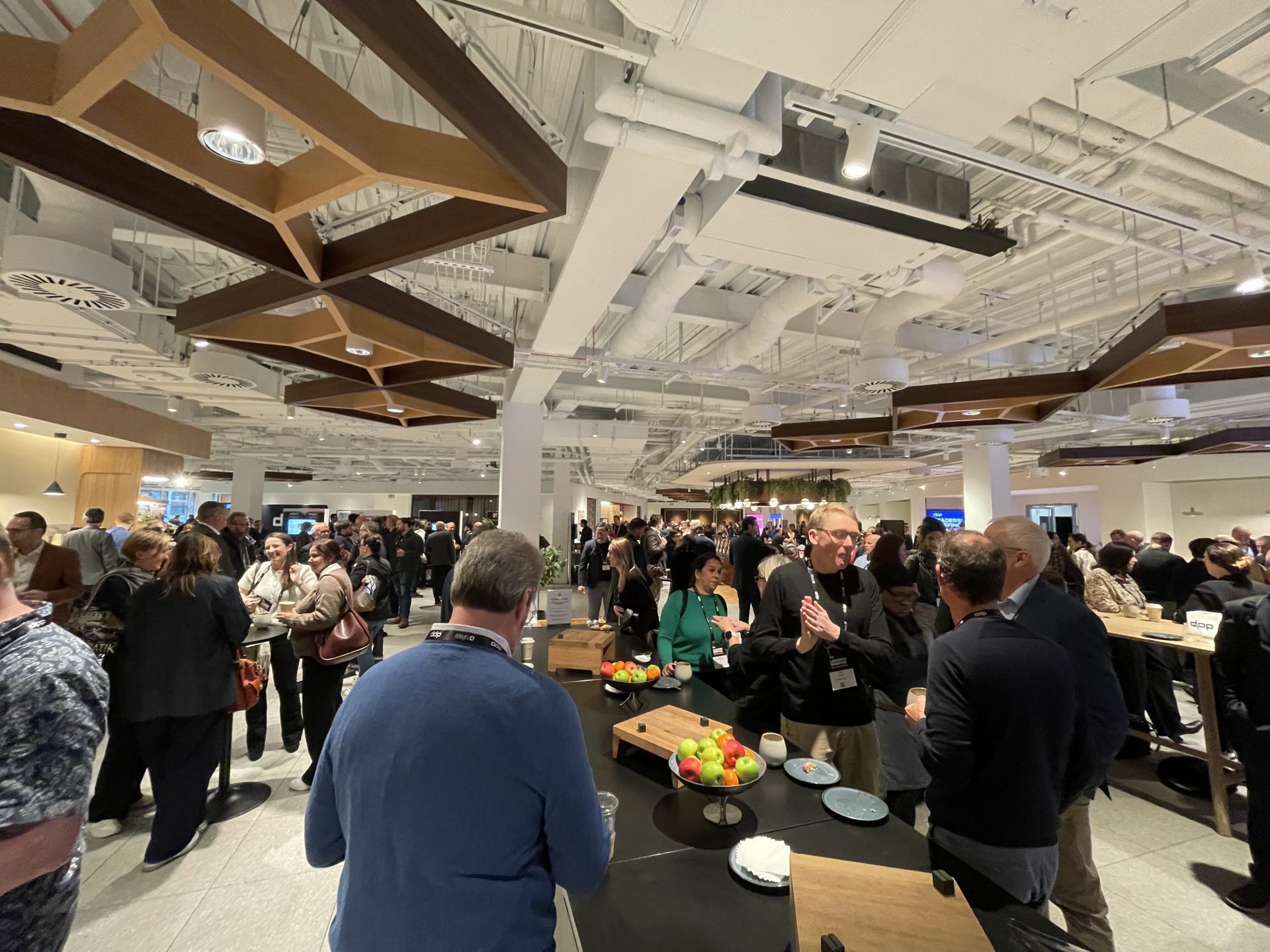
For CEOs media tech partnerships are key to be successful. The DPP provided a space to foster those relationships. Credit: Imaginario AI.
If there was one thing CTOs agreed on, it is that technology is now the easy bit, but people and culture are not.
A DPP chart on leadership challenges placed the biggest challenges on organizational dynamics:
- 75% of CTOs said their biggest issue is change management. Not a specific technology, not a security threat, but the basic job of getting people to work in new ways.
- Securing cross-business engagement came next at 50%.
- Technology project delivery only showed up in the middle.
- Recruiting and retaining talent, securing executive buy-in for tech investment, and keeping employees motivated followed behind.
- Improving diversity within the tech function did appear on the list but was rated by just 9% as their single biggest challenge.
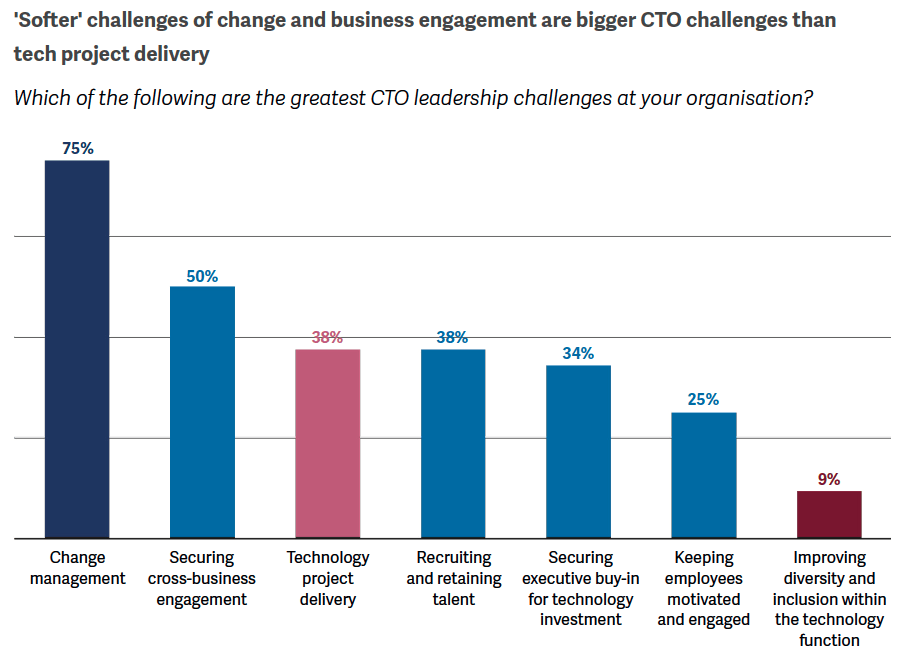
The DPP’s CTO Survey 2025. Management and cross-business engagement remains the main barrier for innovation and AI adoption.
During the conference, plenty of commercial media companies, in particular, said that they need suppliers to act as collaborators rather than just traditional providers.
This was confirmed by the DPP CTO survey: the majority chose “collaborative” as their preferred role for vendors, with only a small minority wanting them to stay “supportive.” Such groups, like Public Service Broadcasters (PSBs) and non-profit organizations, leaned more toward “supportive” than “collaborative,” but very few wanted suppliers to be hands-off in an arm’s-length posture.
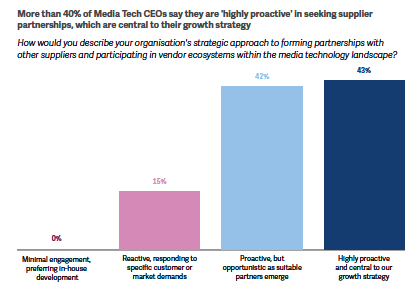
The DPP’s CEO Survey 2025. Technical partnerships are a top priority for leaders in this space with 85% stating they are being proactive or opportunistic. Credit: DPP.
The CEO survey backed that up with a clean headline: 85% of media tech CEOs say they prioritize partnerships. These ecosystems are evolving from simple integrations to “deep collaborations aimed at solving shared customer challenges.” In plain language, everybody realizes they cannot solve this alone at the current pace of innovation in AI.
However, the mood around AI across the event was at the same time strangely cautious for a technology that dominated the conference agenda. Several people warned about “AI FOMO” quietly driving bad decisions.
One NRK executive even said, without much sugar-coating, “Don’t fall into vendor lock-in, I’m not your bitch.” The line landed partly as a joke, but the sentiment was serious.
Organizations want partners who are honest about what they can really deliver, who will give directional pricing and modular solutions early rather than hiding behind all-encompassing solutions and five-year contracts, and who are willing to integrate with rival systems when that is what the customer needs.
AI adoption playbooks that are working in Enterprise

Groupe TF1, with Olivier Penin as Director of Innovation, remains as one of the examples of successful leadership implementing AI at scale. 75 PoCs last year; 20 use cases industrialized including AI native content studios. Credit: DPP.
Advice given during the conference: Start small, with one video workflow, one team, and one function. Use your own content, style guides, and rights data, so the solution reflects your reality. Pick problems where gains are clearly measurable: time saved, errors reduced, fewer manual touches, faster time to air. Keep humans in charge of outcomes.
None of that is glamorous, but it is where the real progress is happening. With Imaginario AI, this is exactly how we have been driving adoption of our solutions: starting small with a limited pilot in a specific function and landing wider corporate-level MSAs later.
Another golden nugget from the event for international media tech vendors: the DPP’s CTO survey mentioned that commercial media companies based in the US are more optimistic about the future (and therefore willing to invest more and experiment) than public service organizations (most of them based in Europe). However, PSBs expect a budget increase next year.
Where this leaves us
Pulling all of these threads together, you get a picture of an industry leaving its AI demo phase and entering the infrastructure phase.
AI and cloud are no longer bolt-ons. They are becoming part of the media supply chain from ingest and logging through post, archive, versioning, localization, compliance, marketing, scheduling, and consumption.
At the same time, most CTOs freely admitted the industry is only at a “developing” stage of maturity. The next three years are about turning experiments into dependable systems.
… and the organizations that seem to be making real progress shared a few traits during the event:
- They treat AI as operational technology, not as an innovation showpiece. As one speaker said: “AI is not the strategy, it’s a means to an end.”
- They keep humans clearly in charge for decision-making and supervision, with AI in a constrained co-pilot role… at least for now.
- They recognize that rights, data, and AI intelligence (in that order) will unlock true value. They invest in in-video metadata, not just asset-level metadata and cloud infrastructure.
- They take change management, specialist partnerships, and world-class UX design as seriously as they take models and buying GPUs.
- Those adapting faster are getting closer to their core strengths in premium content production (e.g., TF1, RTL) rather than trying to build all AI capabilities themselves.
Partners with all-encompassing, monolithic solutions slow companies down rather than help them get to the next wave of video intelligence and automation.
On the contrary, many companies like Freemantle mentioned that partnering with smaller tech vendors normally provided that level of personalized and high-touch support required by Enterprises. Those specializing in AI, need to be API-first, modular, and that serve core areas such as metadata generation/enrichment, model fine-tuning, and training based on the client’s data and context are the perfect co-pilots in this sprint to innovate.
For those of us building AI-enabling solutions and platforms in this space, the engineering and UX bar is high and goes beyond “we have a clever model.”
We need to help enterprises build their own capabilities on their own terms and focusing on specific use cases. Help them with specific AI razor blades with native integrations and modularity, rather than vendor lock-in with middle-of-the-road solutions.
Other challenges vendors need to understand: clients want automation with control, intelligence with explainability, cloud scale with sovereignty (many times fully on-prem), and AI with genuinely human-centered UX. All with full transparency.
The honest reflection of the industry and the openness to collaborate is what rreally defined the DPP Leaders’ Briefing this year.
Behind all the fear slides and maturity charts, you could feel something else: the sense that the industry has stopped arguing about whether this transformation is happening and has started implementing how to do it without breaking the core strengths that made media companies leaders in the first place (hint: premium content).
To their benefit, content is still king and the time to catch the AI wave is now.
About Imaginario.ai
Backed by Techstars, Comcast, and NVIDIA Inception, Imaginario AI helps media companies turn massive volumes of footage into searchable, discoverable, and editable content. Its Cetus™ AI engine combines speech, vision, and multimodal semantic understanding to deliver indexing, simplified smart search, automated highlight generation, and intelligent editing tools.